
Pennsylvania Gambling History

Looking at Pennsylvania’s gambling history, it’s hard not to see how far things have come. The state has always had a somewhat rebellious streak, with off-track betting joints before evolving into Pennsylvania online gambling.
This page covers the highs, lows, and everything in between, so you can appreciate where we’ve been and where we’re headed.
Timeline of gambling legalization in Pennsylvania
From when gambling first took place in Pennsylvania to where it stands today, much has changed.
1682: The ‘Great Law’ prohibits gambling in the state
At a time when card and dice games were incredibly popular, Pennsylvania’s Quaker founders believed gambling was immoral. In 1682, the Pennsylvania legislature passed the “Great Law.”
“And be it further Enacted by the Authority aforesaid that if any Person be Convicted of Playing at Cards Dice Lotterys or Such Like Enticing Vaine and Evill Sports and Games Such persons shall for Every Such offence pay five shillings or suffer five Days imprisonment at hard Labour in the House of Correction,” the law reads.
1855: Pennsylvania takes another swing at outlawing gambling
Organized crime ran a number of gambling establishments in the mid-1800s. Pennsylvania passed a law that banned gambling, but specifically, it made it illegal to own or operate a gambling house.
1959: Horse racing is legalized
In 1959, xf passed the Race Horse Industry Reform Act, which legalized horse racing within the state. A few years later, in 1963, the first legal horse race took place. Then, in 1967, a law was enacted allowing thoroughbred racing in Pennsylvania.
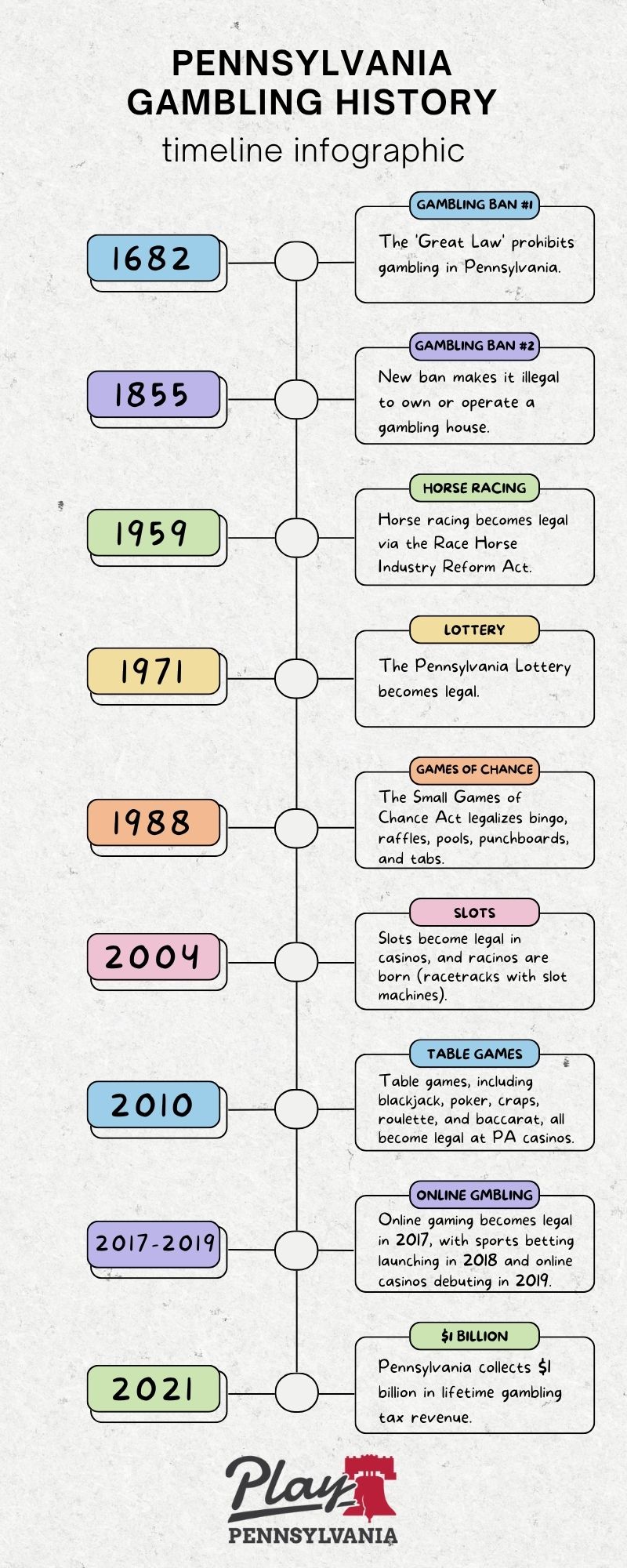
1971: The Lottery is legalized
Shortly after thoroughbred horse racing earned the green light, Pennsylvania passed the 1971 Lottery Act. This was a huge turning point, as the Pennsylvania lottery would go toward a good cause:
“The net proceeds of which are… for the purposes of providing property tax relief for the elderly for taxes paid in 1971 and thereafter to persons 65 years of age or older and for providing certain free fixed route local transit services to persons 65 years of age or older and reduced fare on group ride transit service to persons 65 years of age or older.”
1988: Small Games of Chance Act passes
Originally, this was a way for Pennsylvania to legalize bingo, but the act legalized all games of chance. Think things like raffles, pools, punchboards, and tabs, along with bingo games. Groups could now conduct these “games of chance” in settings like fundraisers.
2004: First legal slot machines appear in Pennsylvania
With Act 71, lawmakers legalized on-site slot machines to help race tracks. This also allowed casinos to offer slots. “Racinos” (racetracks with slot machines) and stand-alone retail casinos emerged during this time. Act 71 also established the Pennsylvania Gaming Control Board, a major step toward overseeing the industry. The board helped direct funds to help the state while also overseeing legality and responsible gaming.
2010: Casinos take shape
With slot machines receiving approval just a few years earlier, Pennsylvania amended the existing law to allow table games. Bettors could finally play household games, such as blackjack, poker, craps, roulette, and baccarat.
2017-2019: PA expands with online gambling
The Expanded Gaming Act was passed in 2017, legalizing online gaming, including casinos, poker, and lotteries. Existing casinos were granted casino licenses, and video gaming terminals (VGTs) were now legal. This act also gave the green light to start prepping for legal sports betting within the state, whenever that would change on a national level.
In 2018, the U.S. Supreme Court cleared the way for legal sports betting across the country. In November 2018, the first-ever legal sports bet was placed in a casino in the state. Not even a full year later, PA online sports betting and Pennsylvania online casinos officially launched. Players were offered competitive PA casino sign-up bonuses to test the new sites coming to the state.
In 2018, the state lottery entered the digital space with the launch of Pennsylvania iLottery, expanding online ticket sales and instant-win games. The move prompted legal challenges from casino operators but ultimately became part of Pennsylvania’s broader regulated gambling ecosystem.
2021: Pennsylvania hits $1 billion in tax revenue
Pennsylvania made history in 2021, becoming the first state to generate more than $1 billion in gambling tax revenue in a single year through the combination of sports betting and casino revenue. The online gambling industry dominated during the COVID-19 pandemic, when many people stayed home.
First legal gambling activities
Horse racing was the first legal form of gambling. This came after much debate about the gambling laws, which many described as outdated. Lawmakers passed this act in hopes of boosting the state’s economy.
The next step was to legalize the lottery system. Lawakers believed this would help residents, as funds were sent back to certain populations and continue to help senior citizens to this day.
From there, gambling as we know it today took shape in the 2000s.
- Slot machines received the green light in 2004 as a way to help racetracks, but they soon appeared in casinos.
- Legalized table games in 2010.
- Online operators were legalized in 2017.
- First online sports bet in 2019.
Key figures in gambling legislation
A number of individuals helped pave the way for the current gambling space — for good and for bad.
Ed Rendell – Pennsylvania governor from 2003 to 2011
Rendell championed gambling expansion in 2004. Years before Pennsylvania legalized betting, Rendell pushed for it as well.
“If it can be done in an effective way, and the state can get some revenue out of it, and it can either further help us reduce property taxes or go to education or things like that, I would do it,” he said in an interview shortly after his time in office concluded.
Kevin O’Toole – Gaming Control Board Executive Director
O’Toole was appointed as the executive director of the Pennsylvania Gaming Control Board in 2009 and remains in that position today. He’s instrumental in the state’s expansion of gambling, so much so that the International Masters of Gaming Law tabbed him as Gaming Regulator of the Year in 2012. O’Toole oversaw the implementation of table games and the transition of gambling to online platforms.
Vince Fumo – Leader in gambling expansion
Fumo was the main architect of the 2004 gambling expansion bill. He pushed for license fee requirements and distributorship rules. Fumo made sure that when Pennsylvania expanded its gambling footprint, local businesses wouldn’t be left out.
“We wanted to be sure that Pennsylvania companies had an avenue to become involved in the new gambling economy. It was a tangible benefit to Pennsylvania companies and Pennsylvania workers,” he said in 2004.
Louis DeNaples – Casino Owner
DeNaples was one of the first owners to receive a casino license in Pennsylvania, operating the Mount Airy Resort Casino. In 2008, Naples was charged with four counts of perjury after lying about his relationship with organized crime. The Pennsylvania Gaming Control Board suspended his license, placed all slot machine revenue from his operation into escrow, and banned him from entering or profiting from the business. Charges were dropped, but DeNaples transferred ownership of the casino to a family trust, and in June of 2009, the license was reinstated. It’s a prime case that highlights the need for background vetting for casino licenses.
How casinos transformed the gambling market
Casinos first took shape after slot machines were introduced to help horse race tracks. Aside from these “racinos” (race tracks with slots), the first modern casinos were introduced. In 2010, the state introduced table games, helping to boost casinos across the state.
Online options also boosted the gaming landscape, as evident by last year’s gaming revenue totals. Slot machines accounted for roughly $2.45 billion in revenue, while table games accounted for $937.2 million. iGaming totaled about $2.18 billion for the year, too. For reference, the entire gaming industry totaled $6.14 billion in revenue last year.
Legalization of online sites for gambling
Sites for gambling were technically legalized in 2017 but didn’t officially launch until 2019.
The massive domino was the Professional and Amateur Sports Protection Act (PASPA) in 2018. This move lets states offer legal sports wagering.
Shortly after, Pennsylvania’s first retail sportsbooks opened in the fall of 2018. Hollywood Casino at Penn National Race Course was the first location to take a bet.
The following year, the state launched online sites for gambling. Just a few months later, in 2019, online betting hit the public. The first platforms Pennsylvanians had access to were PlaySugarHouse Sportsbook, Parx Sportsbook, and BetRivers Sportsbook.
Betting on sports online took off right away, with operators seeing $1.1 billion in handle in 2019. During the COVID-19 pandemic in 2020, casino sites also saw their popularity skyrocket. Compared to 2019 (albeit not a full year during the launch), the state saw a 574% increase in iGaming revenue in 2020.
Notable figures in gambling history in Pennsylvania
George E. Smith
Smith was a horse racing fan in the late 1800s and considered an expert handicapper. After his death, the book “Racing Maxims and Method of ‘Pittsburg Phil'” was released, outlining his wisdom and system for betting on horse racing.
Bill Benter
Benter is a professional gambler who specializes in horse racing. He found statistical patterns that led to successful betting strategies. In turn, he developed a computer software program, from which he earned almost $1 billion. He’s viewed as one of the most successful gamblers in history, not just in the state.
Responsible gambling in Pennsylvania: programs & oversight
Pennsylvania took a major step toward responsible gaming by establishing the Pennsylvania Gaming Control Board. The board made it so operators needed to include compulsive and problem gambling plans, which include self-exclusion programs and accountable gaming notices. The self-exclusion program allows people to voluntarily restrict their access to casinos and online sites. It’s a way for someone to regain control over their gambling habits.
Additionally, the Department of Drug and Alcohol Programs provides gambling counseling services for people of all ages. Pennsylvania views problem gambling in the same realm as other addictions, making sure its residents get the treatment they need.
The Pennsylvania Lottery is also a significant promoter of responsible gaming. The lottery has received numerous recognitions, including those from the National Council on Problem Gambling and the Council on Compulsive Gambling of Pennsylvania.
At PlayPennsylvania, we are committed to ethical coverage in the gambling space. It’s our mission to provide accuracy, balanced information, and education on the gambling space here in PA. We’re transparent about our affiliate relationships to serve as a trusted, transparent, and neutral source of information.
Pennsylvania’s gambling history is evident in today’s market
Looking at the success of the gambling space today, it’s evident how much work went into getting to this point. There were a number of twists and turns along the way, including strong opposition to gambling in the state’s early stages. But thanks to strong leadership and a push to benefit the state, legal gambling is a mainstay today. From racetracks to iPhone apps, Pennsylvania gambling history is as complex as it is fascinating.


